
Sleeping Well in Mauritius: Heat, Humidity and Your Bedroom
13 June 2026 · By Sleep.mu · Updated 16 June 2026
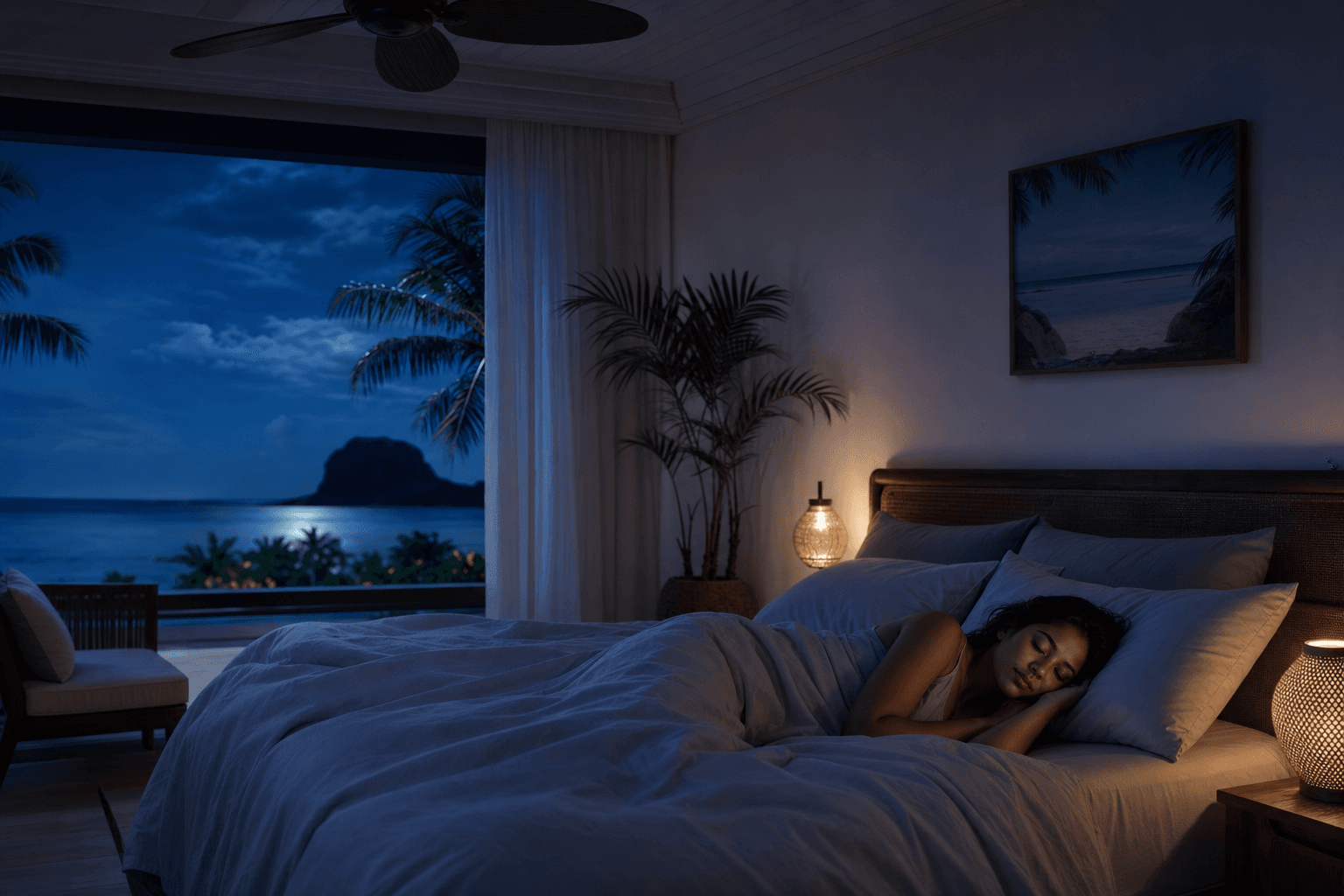
Anyone who has spent a humid January night in Mauritius knows the feeling: sheets that cling, a ceiling fan that only stirs warm air, and sleep that arrives late and leaves early. Heat is not a minor inconvenience for rest. It is one of the most powerful environmental disruptors of sleep we know of, and in a tropical island climate it deserves serious attention.
Why temperature governs sleep
Your body does not fall asleep at a fixed clock time. It falls asleep as your core temperature drops. In the evening, the brain releases melatonin and dilates the blood vessels in your hands and feet, shedding heat from the skin so that core temperature can fall by roughly half a degree to a full degree Celsius. That gentle cooling is the physiological signal that opens the door to deep, slow-wave sleep.
When the bedroom is too warm, that cooling cannot happen. The body cannot offload heat into air that is already hot and saturated with moisture, so core temperature stays elevated. The result is well documented in sleep research: more time awake, lighter sleep, less slow-wave (deep) sleep, and fragmented REM. Heat exposure in particular shortens REM sleep, which matters because REM is where much of our emotional and memory processing happens. You may sleep the same number of hours on a hot night and still wake feeling unrestored.
The numbers that matter in a tropical bedroom
The widely cited comfort zone for sleep is a room temperature of about 18 to 21 degrees Celsius. In Mauritius that target is often unrealistic without air conditioning, especially in the humid coastal lowlands of the north and west where summer nights frequently sit above 25 degrees. The point is not to obsess over hitting 18 degrees, but to move conditions in the right direction.
Humidity is the second variable, and in the tropics it is arguably the bigger problem. The body cools itself largely through the evaporation of sweat. When relative humidity climbs above roughly 60 percent, sweat evaporates poorly, so the cooling mechanism stalls even at moderate temperatures. A room at 26 degrees with dry air feels far more sleepable than the same room at 80 percent humidity. Aim to keep bedroom relative humidity in the 40 to 60 percent range where you can.
Practical cooling, from low cost to high
Start with what is free. Cross-ventilation works: open windows on opposite sides of the room to let the prevailing south-easterly breeze pass through. In the central plateau towns such as Curepipe and Floreal, where nights are naturally cooler and damper, ventilation often does most of the work on its own.
A ceiling or standing fan helps in two ways. It moves air across the skin to aid evaporation, and on humid nights that air movement is more valuable than the small drop in temperature it provides. Position a fan to create a gentle flow over the bed rather than a direct blast, which can dry the airways and wake you.
Bedding and clothing make a real difference. Choose breathable natural fibres such as cotton or linen for sheets and sleepwear, and avoid synthetic materials that trap heat and moisture. Lighter, looser nightwear beats sleeping nude for many people because it wicks sweat away from the skin. A cool shower before bed is a useful trick: it temporarily warms the skin and triggers a rebound drop in core temperature afterwards, nudging you toward sleep.
For air conditioning, you do not need to run it all night. Cooling the room for an hour or two before bed, then switching to a fan or a timer, lowers the starting temperature when it matters most, during sleep onset and early deep sleep. Set the unit no lower than around 24 to 25 degrees to avoid the discomfort and dryness of over-cooling, and clean filters regularly so the air stays fresh.
A dehumidifier is an underrated investment in a coastal Mauritian home. By pulling moisture out of the air it makes a warm room feel cooler and discourages the mould and dust that thrive in humid bedrooms and can disturb breathing during sleep.
Working with the climate, not against it
Tropical living also offers genuine advantages worth protecting. Morning light is abundant and strong, and getting outside soon after waking anchors your circadian rhythm and improves sleep the following night. Keep daytime activity and meals consistent, and try not to let very late, heavy dinners add metabolic heat to an already warm evening.
Seasonal awareness helps too. The Mauritian winter months from around June to September bring cooler, drier nights when sleep tends to come more easily, so reserve your cooling effort and AC budget for the December to March peak. Hydration matters across the night: a warm room means more fluid lost through sweat, so a glass of water within reach prevents the dry, restless waking that dehydration causes.
This kind of environmental fine-tuning sits at the heart of the broader Healthspan philosophy, which treats sleep not as an isolated habit but as something shaped by the spaces, light, and rhythms we live within.
A practical close
You cannot change the island climate, but you can change the cubic metres of air around your bed. Prioritise lowering humidity and moving air before chasing a precise temperature, choose breathable bedding, cool the room before sleep rather than fighting heat at 2am, and let the bright tropical mornings do their work on your body clock. Small, consistent adjustments to your bedroom environment will return far more restful nights than any single gadget, even through the warmest Mauritian summer.
Good sleep is the foundation of a longer, healthier life. Explore the wider Healthspan health ecosystem.